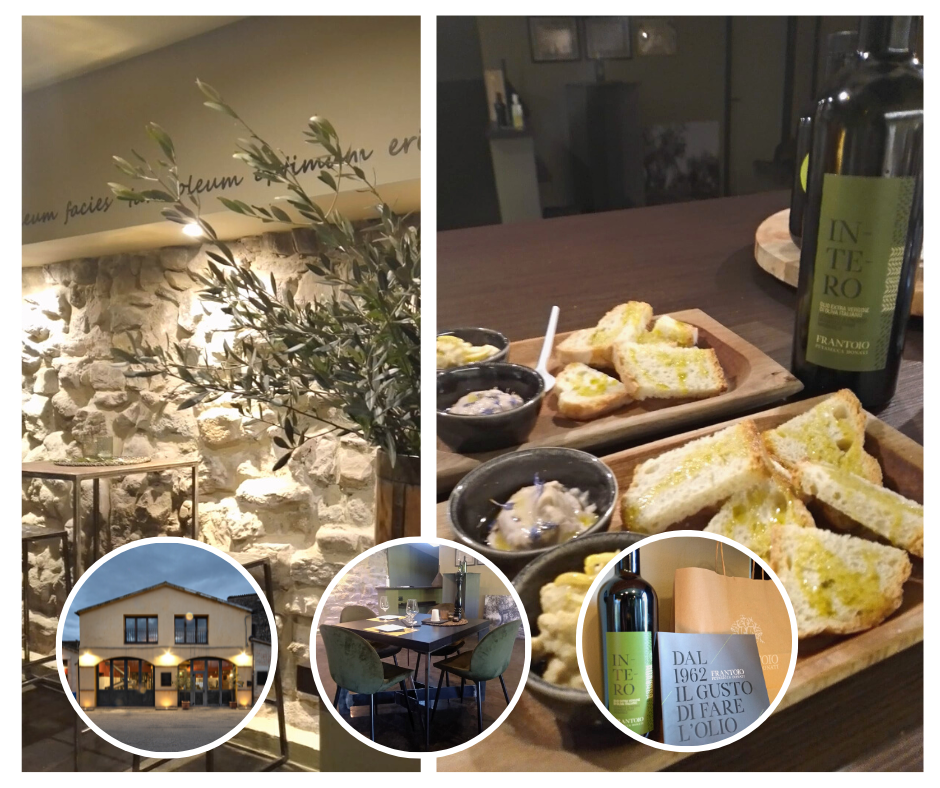
Amidst the green hills of the Strada del Sagrantino, the olive tree stands out.A highly long-lived and slow-growing plant, it may well represent the region's ability to lovingly preserve age-old traditions, as in the case of the centuries-old olive trees of Giano dell'Umbria, handed down from generation to generation, and the tasty Umbrian extra virgin olive oil best represents the region's gastronomy, made up of straightforward dishes of genuine and flavoursome food. The olive trees cultivated in Umbria enjoy special climatic conditions that allow the fruit to ripen very slowly, resulting in an extremely low level of acidity.
Particular importance is attributed to soils located on hillsides, mostly in foothills: soils rich in structure, and very permeable, which allow the roots of the plant to penetrate easily. To these pedoclimatic data must be added the contribution made by man. Firstly, the olive harvest: no longer waiting for the olives to reach the end of their natural ripening stage, it has become a general recommendation to harvest them when they reach the beginning of ripening, i.e. when they are semi-bearing and have both maximum fruitiness and minimum acidity. This state is usually obtained in the first few days of November. As soon as they are picked, the olives do not wait for the harvest to be completed but are immediately forwarded to the mill to be processed in their maximum freshness and integrity.
The extra virgin olive oil produced in the municipalities of the Strada del Sagrantino can claim the 'Denominazione di Origine Protetta Umbria Colli Martani' , which is one of the five sub-zones into which the region has been divided. The prevailing cultivar in the Colli Martani is the San Felice, a local variety that, thanks to its greater bitterness, allows the Colli Martani extra virgin olive oil to compensate for the typical sourness of Umbrian oil due to the almost total presence of 'moraiolo' olives. The extra virgin olive oil that refers to this PDO is obtained from the following olive varieties: Moraiolo at a minimum of 20%; S. Felice, Leccino and Frantoio, present alone or combined, at a maximum of 80%. Other varieties may also be used up to a maximum limit of 10%.
Amidst the green hills of the Strada del Sagrantino, the olive tree stands out.A highly long-lived and slow-growing plant, it may well represent the region's ability to lovingly preserve age-old traditions, as in the case of the centuries-old olive trees of Giano dell'Umbria, handed down from generation to generation, and the tasty Umbrian extra virgin olive oil best represents the region's gastronomy, made up of straightforward dishes of genuine and flavoursome food. The olive trees cultivated in Umbria enjoy special climatic conditions that allow the fruit to ripen very slowly, resulting in an extremely low level of acidity.
Particular importance is attributed to soils located on hillsides, mostly in foothills: soils rich in structure, and very permeable, which allow the roots of the plant to penetrate easily. To these pedoclimatic data must be added the contribution made by man. Firstly, the olive harvest: no longer waiting for the olives to reach the end of their natural ripening stage, it has become a general recommendation to harvest them when they reach the beginning of ripening, i.e. when they are semi-bearing and have both maximum fruitiness and minimum acidity. This state is usually obtained in the first few days of November. As soon as they are picked, the olives do not wait for the harvest to be completed but are immediately forwarded to the mill to be processed in their maximum freshness and integrity.
The extra virgin olive oil produced in the municipalities of the Strada del Sagrantino can claim the 'Denominazione di Origine Protetta Umbria Colli Martani' , which is one of the five sub-zones into which the region has been divided. The prevailing cultivar in the Colli Martani is the San Felice, a local variety that, thanks to its greater bitterness, allows the Colli Martani extra virgin olive oil to compensate for the typical sourness of Umbrian oil due to the almost total presence of 'moraiolo' olives. The extra virgin olive oil that refers to this PDO is obtained from the following olive varieties: Moraiolo at a minimum of 20%; S. Felice, Leccino and Frantoio, present alone or combined, at a maximum of 80%. Other varieties may also be used up to a maximum limit of 10%.