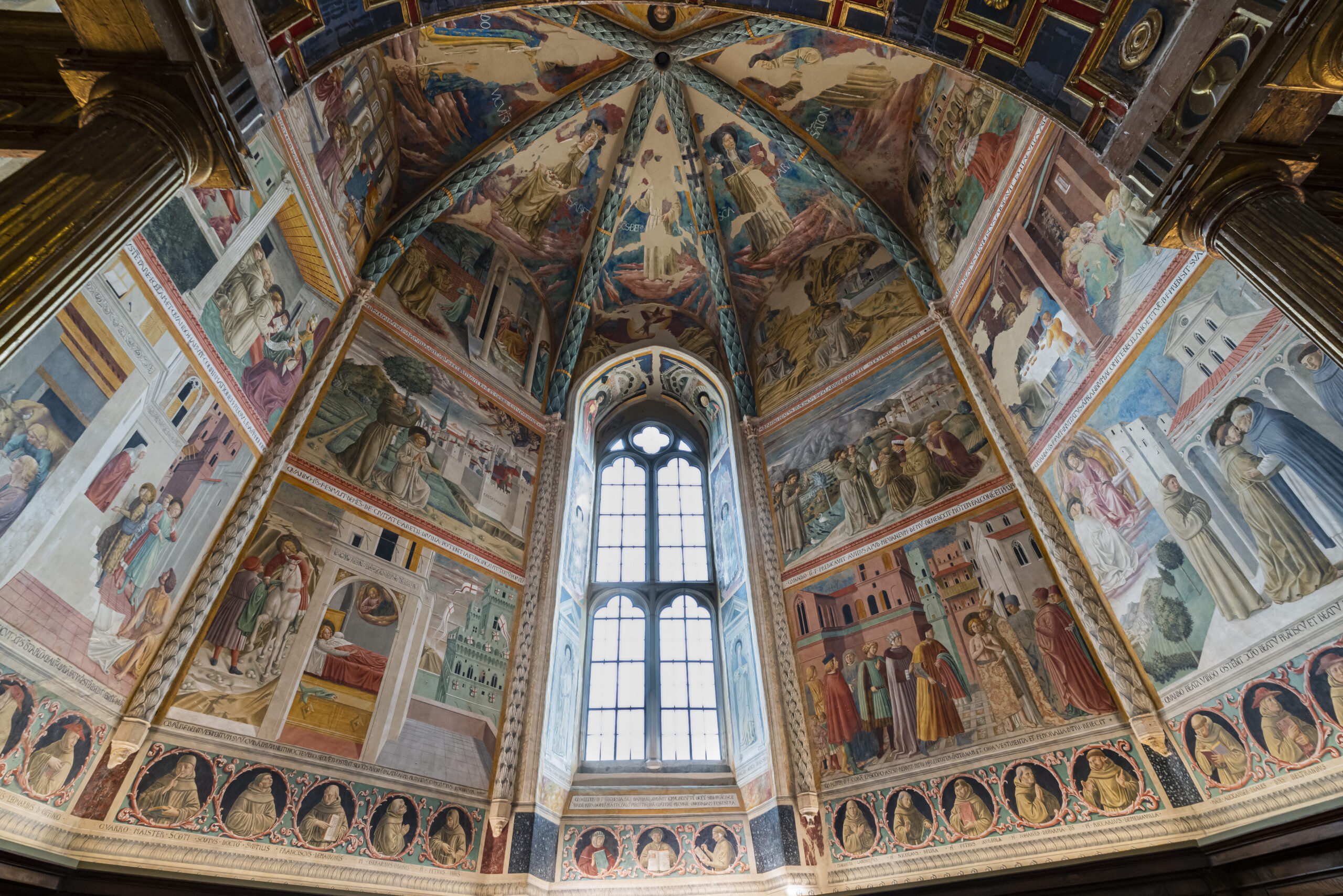

The Convent is located just over a kilometer from the village of Montefalco, perched on top of a hill: a mystical place rich in time in the Pieve di San Fortunato art and silence intertwine in a unique story.
San Fortunato is the patron saint of Montefalco, together with Santa Chiara della Croce, and the town is bound to his figure by a strong devotion. It is said that from the stick that Fortunato planted in the ground, a holm oak plant came to life. The plant believed to be St Fortunato's, now a very tall tree, can still be seen in the holm oak forest on the property.
All that remains today of the older church, built over his remains, are the four Roman columns, repurposed into the space of the four-sided courtyard in front of the church, rebuilt in the Renaissance period, and the numerous epigraphic and stone remains from the same period, some of which are preserved here and some in the nearby Museum of St Francis.
In the beautiful four-sided entrance porch to the church is the magnificent “Cappella delle “Rose”, created by Tiberio d'Assisi in 1512 and dedicated to the stories of the Perdono d’Assisi. The main scene behind the altar depicts St Francis' request to Madonna dell’indulgenza del Perdono per Assisi, the Indulgence of the Portiuncula. Exquisitely crafted, in the vault, the Blessing Almighty is surrounded by cherubim and seraphim.
The Friars Minor were the first to request in Montefalco the intervention of the famous Renaissance painter Benozzo Gozzoli's masterpiece, author of the beautiful cycle of frescoes in the nearby Church of San Francesco, now part of the museum. In fact, the 1450 fresco in the lunette above the entrance portal to the church, depicting the "Madonna col Bambino tra San Francesco e San Bernardino da Siena e sette Angeli ", is by his hand.
.
.
Inside the church, on the left, there is an ancient restored chapel, with decorations by the late 15th-century Montefalco painter Francesco Melanzio, in which the sarcophagus of St. Severus, dating back to the 4th or 5th century, is preserved, with the paintings Ecce Homo and two very deteriorated Adoring Angels attributed to Benozzo Gozzoli.
It also houses a copy of the beautiful panel painting made in 1450 by Benozzo Gozzoli for the high altar of the church, according to the most up-to-date dictates of Renaissance taste, the "Madonna of the Cintola" altarpiece. The original panel is currently exhibited in the Vatican Museums, as it was donated by the Municipality of Montefalco to Pius IX in 1848 to obtain the title of "city". It was recently restored thanks to the synergic intervention of local entrepreneurs, producers of excellences sensitive to the valorisation of the territory, the museum manager and the promoting public bodies who, together in integrating the contribution, made the work skilfully conducted at the Vatican Museums' laboratories possible.
In the woods adjacent to the monastery are the so-called “Grotte di S. Fortunato”, probably originally a pagan temple dedicated to the goddess Mithras, an underground oratory from the early Christian era, later used for the worship of Christianity. These caves were chosen several times by the Saint himself as a place of retreat. They are chambers excavated in a bank of breccia and clay, including the central one in the shape of a cross, probably used as an oratory.